Twin-screw extrusion is widely used not only to melt and blend polymers, but also as a continuous processing platform for incorporating liquid additives into polymer formulations. Oils, plasticizers, monomers, fragrances, water, pigments, and other liquids can be introduced directly into the extruder at controlled locations and rates.
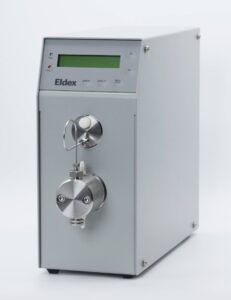
Eldex reciprocating piston pumps are particularly well suited for precision liquid injection into extruders when the application requires low flow rates, high discharge pressure, and repeatable dosing. Their positive-displacement operating principle enables controlled liquid delivery against the pressure generated within the extruder.
For these applications, the liquid injection system must do more than deliver a specified flow rate. It must overcome extruder pressure, maintain consistent dosing over time, and accommodate the fluid’s viscosity, temperature, and chemical composition.
This application note discusses using Eldex pumps for liquid injection into single- and twin-screw extruders, with particular attention to mineral oil addition, reactive processing, and other liquid additives.
Key considerations for selecting a liquid injection pump for an extruder include:
- Required liquid flow rate
- Extruder pressure at the injection point
- Liquid viscosity
- Operating temperature
- Chemical compatibility
- Number and location of injection points
Eldex Pump Capabilities for Extrusion Applications:
- Pressure capabilities up to 6,000 psi / 413 bar
- Flow ranges from 0.002–2.5 mL/min on the smallest models up to 200 mL/min
- 316 SS, PEEK and Hastelloy-C-276 configurations
- Best suited for fluids below 200 cP
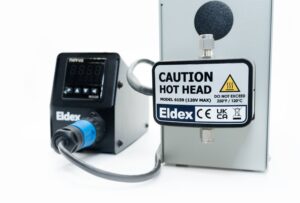
- Temperatures up to 200°C/392°F or 260°C/500°F with ceramic/PEEK check valves
Liquid Injection in Extrusion
Liquid injection is performed through a dedicated port in the extruder barrel. The liquid is metered into the polymer melt while the screws provide the mixing, conveying, and, in reactive extrusion, the reaction environment.
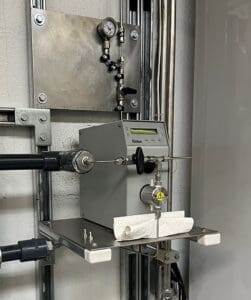
A typical injection system consists of the following:
- Liquid reservoir
- Liquid additive pump
- Back pressure regulator
- pressure gauge
- injection nozzle
- extruder barrel

As shown in the photo to the left, the Eldex pump provides controlled liquid feed, while the injection hardware delivers the liquid into the pressurized extruder. Injection nozzle design and injection-point location can vary by extruder manufacturer and depend on the specific application, liquid being injected, and screw configuration. The required injection pressure depends primarily on the pressure within the extruder at the injection location. Consequently, select the pump based on both the required flow rate and discharge pressure, not flow rate alone.
Why Use a Reciprocating Piston Pump For Extruder Liquid Injection
Liquid additives can be introduced into an extruder using various technologies, including gear pumps, diaphragm pumps, peristaltic pumps, and other metering systems.
Reciprocating piston pumps provide several characteristics that are particularly useful when low liquid flow rates and relatively high injection pressures are required.
Positive displacement
A reciprocating piston pump meters a defined volume of liquid during each pumping cycle. This makes the delivered flow primarily dependent on piston displacement and pumping speed rather than the pressure generated by the downstream process.
This is especially useful when extruder pressure varies or is inconsistent during operation.
High pressure capability
An extruder can operate at substantial internal pressure, so the injection pump must have sufficient pressure capability to maintain flow into the barrel. Eldex reciprocating piston pumps are available with pressure capabilities up to 6,000 psi (413 bar), providing ample pressure capacity for liquid injection across a wide range of extrusion processes.
Low-flow metering
Many extrusion applications require relatively small liquid flow rates compared with the overall polymer throughput. Eldex offers a range of reciprocating piston pumps to accommodate different injection requirements, from the smallest models with flow ranges of 0.002–2.5 mL/min to larger models capable of 200 mL/min. This range lets you match the pump to applications requiring precise, low-flow liquid injection and higher-rate additive delivery.
Flexible materials and configurations
Eldex pumps are available in 316 SS, PEEK, and Hastelloy-C-276 configurations, with wetted materials selected to suit different chemical and process requirements. 316 stainless steel pumps use 316 SS, GFP, PCTFE (Kel-F), sapphire, and ruby; PEEK pumps use PEEK, UHMW polyethylene, sapphire, and ruby; and Hastelloy pumps use Hastelloy-C-276, GFP, PCTFE (Kel-F), sapphire, and ruby. Evaluate the complete wetted flow path for chemical compatibility with the injected liquid, including pump parts, external tubing, fittings, and the injection nozzle. Because of the Eldex ball/seat check valve design, pumps are most effective for fluids with viscosity below 200 cP.
How are Metering Pumps Used for Mineral Oil Addition in Polymer Extrusion?
One such liquid injection application is adding mineral oil to styrene polymers, where controlled oil injection can tailor properties such as flowability, melt viscosity, flexibility, hardness, elongation at break, and impact strength. Patent DE10331451A1 describes producing styrene polymers containing 8–50 wt.% mineral oil by introducing the oil through multiple feed openings in an extruder, with mixing or kneading elements located near the injection points.
The mineral oils described in the patent have relatively moderate viscosities; the example oil has a viscosity of approximately 61 cP at 40°C, making the application well suited to Eldex liquid metering pumps. The patent also states that the oil temperature can range from -20 to 200°C, with 0-60°C preferred, falling within Eldex pumps’ operational limits of 200°C/392ºF, or up to 260°C/500ºF with ceramic/PEEK check valves. The required injection pressure depends in part on the pressure of the material inside the extruder.
This combination of moderate liquid viscosity, controlled flow, and injection into a pressurized process makes mineral oil addition a suitable application for a positive-displacement reciprocating piston pump. Eldex currently supports mineral oil injection applications, providing controlled liquid metering into pressurized extrusion processes.
The patent describes using at least two mineral oil injection openings. When a relatively large amount of liquid must be incorporated, distributing the addition over multiple injection locations can help the polymer absorb and disperse the liquid progressively. For a flow process incorporating Eldex pumps, each injection location can be supplied by its own pump, or the application can be configured around the required number of injection points and flow rates.
Reactive Extrusion
Not every liquid injected into an extruder is simply an additive.
In conventional additive processing, materials such as mineral oil or plasticizers are incorporated into the polymer and distributed throughout the melt. The goal is generally physical mixing rather than chemical reaction.
In reactive extrusion, the extruder acts as a continuous chemical reactor. Monomers, peroxides, catalysts, initiators, chain extenders, and reactive compatibilizers can be injected into the polymer stream so that a chemical reaction occurs during the material’s residence time inside the extruder. Other liquids, such as plasticizers, solvents, and processing liquids, can also be introduced to modify the formulation or processing conditions.
Research on reactive extrusion describes twin-screw extruders as continuous reactors for polymer polymerization and chemical modification. The process involves coupled effects including mixing, diffusion, temperature, viscosity, residence time, and reaction kinetics.
This makes controlled liquid addition particularly important, as with other traditional high-pressure reactors.
The pump must deliver the reagent at the required concentration and rate while the extruder controls the mixing and reaction environment. Please refer to our high-pressure reactor blog found here for more information on controlled liquid injection into monitored reactive environments.
https://www.eldex.com/2026/07/13/precision-liquid-injection-into-high-pressure-reactors/
https://www.eldex.com/2026/06/05/eldex-optos-series-for-high-pressure-flow-catalysis/
Water, Oils, Plasticizers, and Other Low-Rate Liquids
Of course, low-rate liquid injection is not limited to reactive extrusion. The same basic injection approach can introduce non-reactive liquids and additives other than the previously discussed mineral oil into a polymer melt with controlled, consistent flow.
Plasticizers
Plasticizers can be metered into the polymer stream, often downstream of the main polymer feed, to modify flexibility and stiffness while improving melt processing and flow.
Water
Water can be injected for processing, cooling, foaming, or other specialized extrusion applications, depending on the material and operating conditions.
Fragrances and Liquid Pigments
Fragrances can be added to polymers used in products such as packaging, films, consumer goods, and household products where a controlled scent is desired. Liquid pigments and colorants can be injected during extrusion to produce consistently colored plastic pellets, films, fibers, and other finished products.
From Additive Dosing to Continuous Chemical Processing
Liquid injection expands an extruder’s capabilities beyond feeding solid polymers and additives through the main hopper. By introducing liquids at controlled locations along the screw profile, processors can precisely manage how additives, processing aids, or reactive chemicals are incorporated into the polymer melt.
The purpose of the liquid injection can vary significantly by application. In mineral oil, plasticizer, pigment, or fragrance addition, the objective is typically consistent dosing and uniform dispersion throughout the polymer. In reactive extrusion, precise liquid delivery becomes part of the chemical process itself, where the concentration and feed rate of a monomer, catalyst, initiator, or other reagent can influence the reaction occurring inside the extruder.
Regardless of the application, successful liquid injection depends on delivering the fluid consistently at the required flow rate and at sufficient pressure to overcome conditions at the injection point.
Eldex reciprocating piston pumps are well suited to these requirements, combining precise low-flow metering with the high-pressure capability needed to inject liquids into pressurized extrusion processes. By matching pump flow rate, pressure capability, wetted materials, and operating temperature to the application, Eldex pumps can provide reliable liquid delivery for applications ranging from additive dosing to continuous chemical processing.
Conclusion
For applications requiring relatively low liquid flow rates and significant injection pressure, an Eldex reciprocating piston pump can provide the positive-displacement metering needed to maintain controlled addition. The most successful systems consider the pump, liquid properties, tubing, injection nozzle, extruder pressure, temperature, and screw configuration as one integrated system.
Whether the objective is adding mineral oil to a styrene polymer or precisely dosing a reactive chemical into a continuous polymerization process, Eldex pumps can provide a controlled liquid feed to the extrusion process.
For assistance selecting an Eldex pump for your extrusion application, contact our team by email or phone at 707-224-8800 to discuss your specific liquid injection requirements.